IEEE Robotics and Automation Letters, vol. 11, no. 4, 2026

A Nonlinear MPC Framework for Loco-Manipulation of Quadrupedal Robots With Non-Negligible Manipulator Dynamics

Ruturaj S. Sambhus1* Kapi Ketan Mehta1* Ali MirMohammad Sadeghi1* Basit Muhammad Imran1 Jeeseop Kim2 Taizoon Chunawala1 Vittorio Pastore1 Sujith Vijayan3 Kaveh Akbari Hamed1

1 Mechanical Engineering, Virginia Tech
2 The University of Texas at El Paso
3 School of Neuroscience, Virginia Tech
* Equal contribution

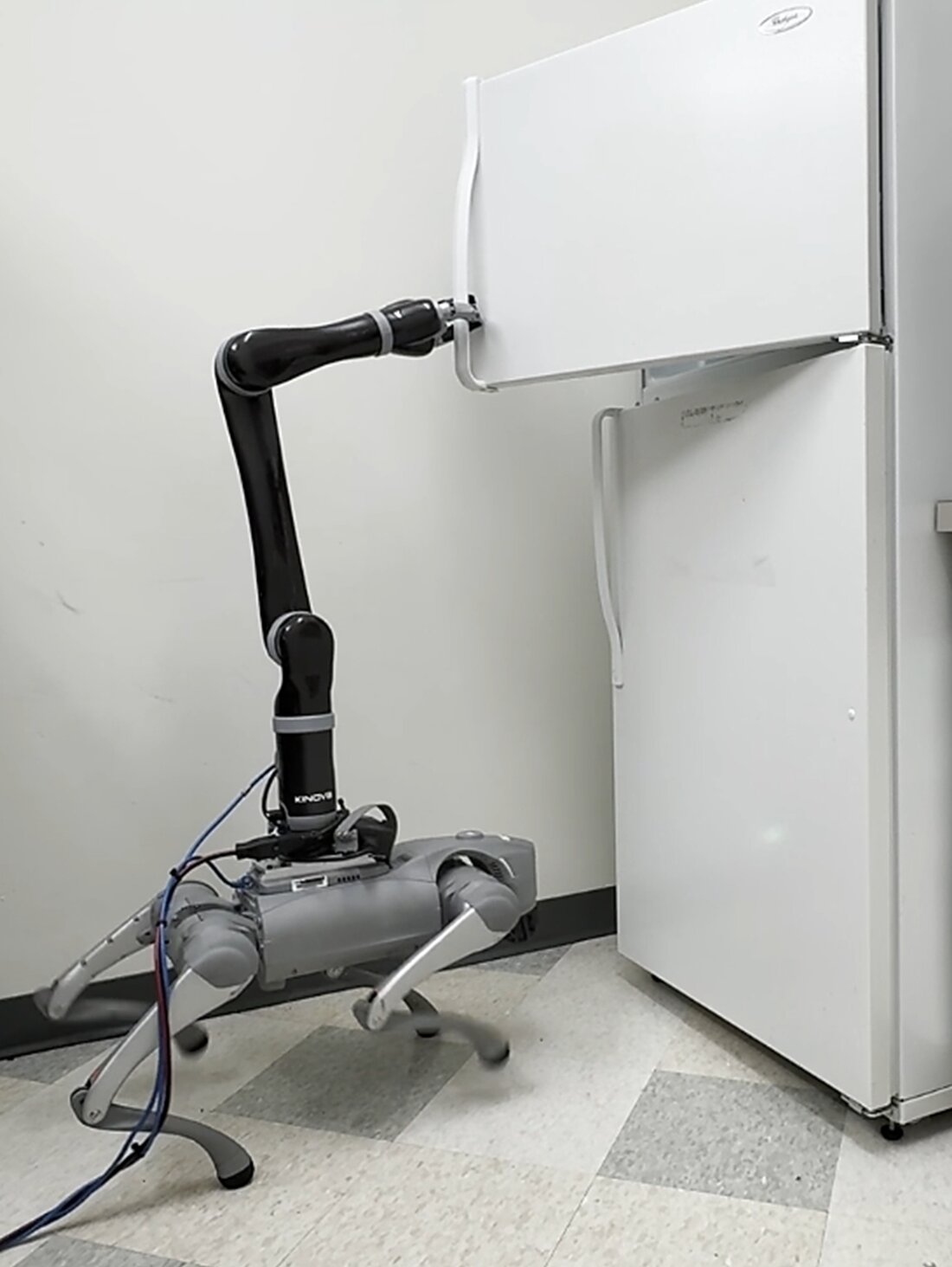
The Go2 quadruped with a Kinova arm on its back pulls open a refrigerator door that stands well above the robot.

A 4.4 kg arm on a 15 kg quadruped is too heavy to treat as a disturbance. We keep a compact single-rigid-body template for locomotion, keep the full-order dynamics of the arm, and couple the two through rigid holonomic constraints. One nonlinear MPC solves for the base motion, the arm torques and the wrench between them at 60 Hz.

Read the abstract

Model predictive control (MPC) with reduced-order template models has proven effective for dynamic legged locomotion, but loco-manipulation introduces additional complexity requiring efficient algorithms for high-degree-of-freedom (DoF) systems. This letter presents a computationally efficient nonlinear MPC (NMPC) framework tailored for loco-manipulation tasks of quadrupedal robots equipped with robotic manipulators whose dynamics are non-negligible relative to those of the quadruped. The proposed framework adopts a decomposition strategy that couples locomotion template models—such as the single rigid body model—with a full-order dynamic model of the robotic manipulator for torque-level control. This decomposition enables efficient real-time solution of the NMPC problem in a receding horizon fashion. The optimal state and input trajectories generated by the NMPC for locomotion are tracked by a low-level nonlinear whole-body controller, while the optimal torque commands for the manipulator are directly applied. The layered control architecture is validated through extensive numerical simulations and hardware experiments on a 15-kg Go2 quadrupedal robot augmented with a 4.4-kg 4-DoF Kinova arm. Given that the Kinova arm dynamics are non-negligible relative to the Go2 base, the proposed NMPC framework demonstrates robust stability in performing diverse loco-manipulation tasks, effectively handling external disturbances, payload variations, and uneven terrain.

Mass, drawn to scale. None of the loads is modeled in the controller.
Robot
Go2 15 kgArm 4.419.4 kg
Cart it pushes
Cart 13 kgPayload 11.4 kg24.4 kg
Suitcase it pulls
3.7 kg
Payload in gripper
1 kg

Video

Supplementary video, 7 min 25 s. Watch on YouTube.

Hardware experiments

The operator sends velocity commands to the base and arm with a joystick. The controller has no terrain perception and no model of the objects it handles. Clips play at real speed unless marked.

Refrigerator Opens the door and takes out a bottle. 5× speed, cut
Wooden blocks Trots over unmodeled 5 cm blocks with a 1 kg payload.
Drawer Opens it, takes out a penholder cup, closes it and sets the cup on a table. 5× speed
Pick and place Picks up a Rubik’s cube and places it. 3× speed
Perception in the loop RealSense and an ArUco marker set the arm reference.
Lab door Opens a door without a spring and walks through. 2× speed
Loaded cart Pushes a 13 kg cart while a person adds 11.4 kg, about 125% of the 19.4 kg robot in total.
External pushes Trots in place with a 1 kg payload while being pushed.
Suitcase Pulls a 3.7 kg carry-on.
Grass Walks outdoors with the arm raised.
Gravel Walks on loose gravel.

Method

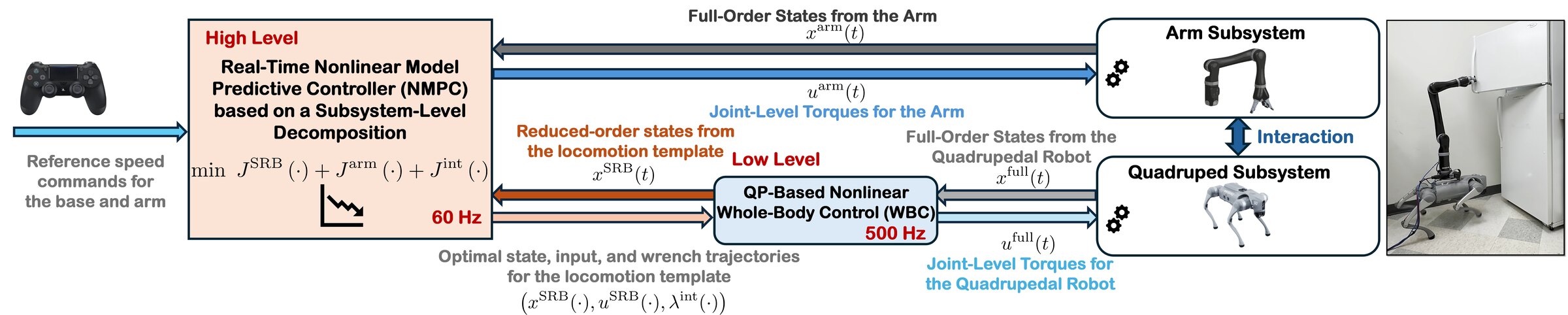
Two subsystems keep their own dynamics. The constraint that bolts the arm to the trunk is the only place they meet, and the interaction wrench λint is a decision variable of the MPC.

Layered control architecture. The NMPC runs at 60 Hz and sends joint torques to the arm and locomotion trajectories to a whole-body controller, which runs at 500 Hz and sends joint torques to the quadruped.

Locomotion template

Single rigid body, 12 states. Ground reaction forces are the inputs.

$$\begin{aligned}\ddot p &= \tfrac{1}{m}f^{\mathrm{net}}-g_0\\ \dot\theta &= A(\theta)\,\omega\\ \dot\omega &= I^{-1}\!\left(\tau^{\mathrm{net}}-\mathbb S(\omega)I\omega\right)\end{aligned}$$

Rigid coupling

Holonomic constraint φ = 0, enforced at the acceleration level.

$$\begin{aligned} p+R(\theta)\,d&=p^{b}\\ \theta&=\theta^{b}\end{aligned}$$ $$\ddot\varphi\left(x^{\mathrm{SRB}},x^{\mathrm{arm}},u^{\mathrm{SRB}},u^{\mathrm{arm}},\lambda^{\mathrm{int}}\right)=0$$

Full-order arm

Floating base, 20 states. Four joint torques are the inputs.

$$D(q)\,\ddot q+H(q,\dot q)=B\,u^{\mathrm{arm}}-J^{\top}(q)\,\lambda^{\mathrm{int}}$$

Unified NMPC

$$\begin{aligned}\min_{\xi^{\mathrm{SRB}},\,\xi^{\mathrm{arm}},\,\lambda^{\mathrm{int}}}\quad & J^{\mathrm{SRB}}(\xi^{\mathrm{SRB}})+J^{\mathrm{arm}}(\xi^{\mathrm{arm}})+J^{\mathrm{int}}(\lambda^{\mathrm{int}})\\ \text{s.t.}\quad & x^{\mathrm{SRB}}_{k+1}=f^{\mathrm{SRB}}\!\left(x^{\mathrm{SRB}}_{k},u^{\mathrm{SRB}}_{k},\lambda^{\mathrm{int}}_{k}\right)\\ & x^{\mathrm{arm}}_{k+1}=f^{\mathrm{arm}}\!\left(x^{\mathrm{arm}}_{k},u^{\mathrm{arm}}_{k},\lambda^{\mathrm{int}}_{k}\right)\\ & \ddot\varphi\left(x^{\mathrm{SRB}}_{k},x^{\mathrm{arm}}_{k},u^{\mathrm{SRB}}_{k},u^{\mathrm{arm}}_{k},\lambda^{\mathrm{int}}_{k}\right)=0\\ & E\,u^{\mathrm{SRB}}_{k}=0,\quad u^{\mathrm{SRB}}_{k}\in\mathcal U^{\mathrm{SRB}},\quad u^{\mathrm{arm}}_{k}\in\mathcal U^{\mathrm{arm}},\qquad k=0,\dots,N-1\end{aligned}$$
NMPC rate
60 Hz
Horizon
N = 8, Ts = 16.67 ms
Decision variables
464
Solver
CasADi + IPOPT, at most 10 iterations, warm-started
Mean solve time
12.7 ms on rough terrain, 13.6 ms under pushes
Whole-body controller
QP with virtual constraints, 500 Hz
Computer
Offboard Intel Core i9-12900F, 64 GB RAM
Gait
Trot, 200 ms step

Results

Robustness on 200 random terrains

Go2 with the Kinova arm in RaiSim at 0.5 m/s. Each terrain has 20 irregular blocks, 1–3 cm high. A run succeeds if the robot covers 10 m with roll and pitch within ±1 rad and base height of at least 0.08 m.

ControllerRateSuccess at 10 m
Decomposition, nonlinear arm inertia and Coriolis (ours)30 Hz90%
Decomposition, nonlinear arm inertia (ours)30 Hz88%
Decomposition, successively linearized inertia (ours, used on hardware)60 Hz86%
Kino-centroidal NMPC, arm inverse dynamics60 Hz69%
Whole-body NMPC, ProxDDP100 Hz35%
Kino-centroidal NMPC, arm PD60 Hz28%

The kino-centroidal baselines leave out the coupling between joint torques and the floating-base arm dynamics. The whole-body baseline puts all states and torques in one optimization, which makes it more sensitive to disturbances.

The full nonlinear arm inertia and Coriolis terms add a few points of success and roughly double the computation time, so the 60 Hz linearized variant runs on the robot.

Base motion on hardware

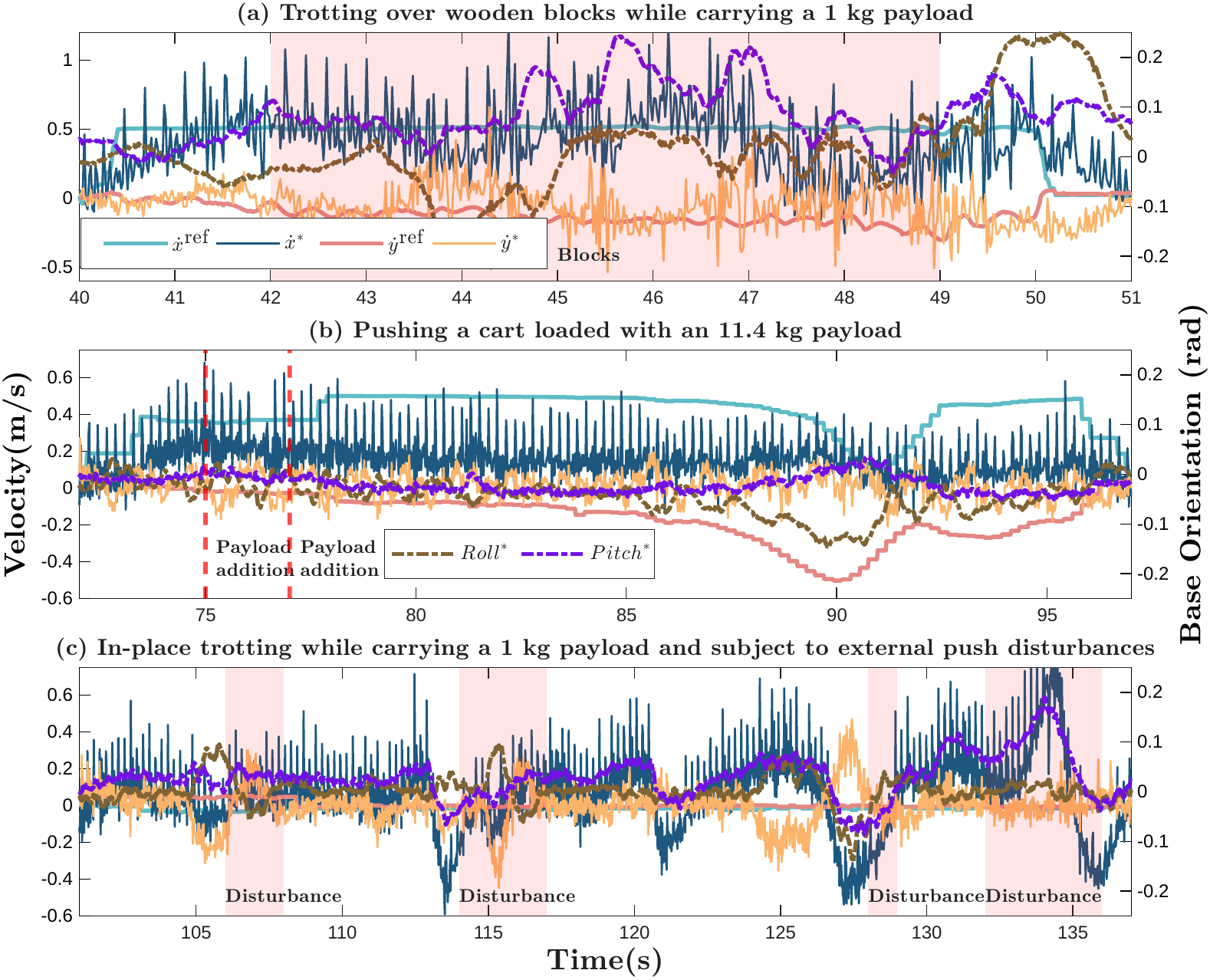
Reference and optimal base velocities with roll and pitch for three experiments: wooden blocks, loaded cart and external pushes.
Commanded and NMPC-optimal base velocities with roll and pitch: (a) wooden blocks with a 1 kg payload, (b) cart with an 11.4 kg payload, (c) in-place trot under pushes.

Arm motion

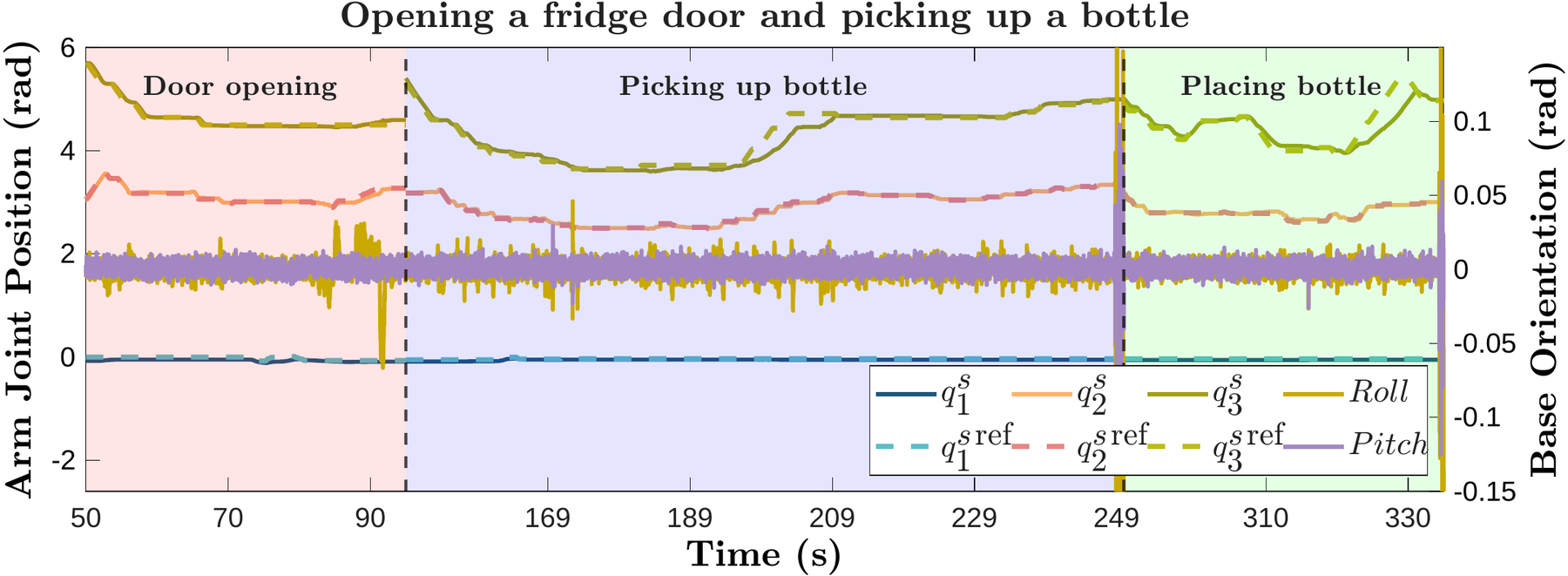
Reference and actual positions of three arm joints while opening the refrigerator, picking up a bottle and placing it.
Reference and actual joint positions for three of the four Kinova joints during the refrigerator task, with base roll and pitch.

In simulation, four controllers tracked 0.1–0.2 Hz sinusoidal arm references while trotting. We found no significant difference in arm tracking between them.

RMS tracking error (rad)Joint 1Joint 2Joint 3
Decomposition, nonlinear inertia and Coriolis (ours)0.04870.15540.0711
Decomposition, successively linearized inertia (ours)0.01680.09460.0225
Whole-body NMPC, ProxDDP0.05460.05510.1202
Kino-centroidal NMPC, arm inverse dynamics0.00910.00900.0172

On hardware, the same sinusoids gave RMS errors of 0.1740, 0.2058 and 0.2246 rad, mainly from unmodeled joint friction.

Communication latency

We simulated two-way delays of 5–25 ms between arm feedback and torque commands. The closed loop stayed stable up to 15 ms. Mild arm oscillations appeared as the delay approached 25 ms.

Another quadruped

The same controller also runs in simulation on a 12.45 kg Unitree A1 with the same arm. We did not test it on hardware because the A1 has lower torque limits than the Go2.

Unitree A1 with the Kinova arm in RaiSim.

Code

The C++ controller is open source under GPL-3.0. The repository has the NMPC and its CasADi code generation, the whole-body QP, RaiSim simulations of the Go2 and A1 with the Kinova arm, and the Go2 hardware program. It also includes the CAD for the arm mount.

Open the repository

Build

git clone https://github.com/HDSRL/Locomanipulation_NMPC_Go2_Kinova.git
cd Locomanipulation_NMPC_Go2_Kinova

# gamepad library, once
cmake -S JoyShockLibrary -B JoyShockLibrary/build -DCMAKE_BUILD_TYPE=Release
cmake --build JoyShockLibrary/build -j

bash runCodegenA1K.sh   # generate the NMPC solver
bash cmakemake.sh       # build everything

cd build && mkdir -p tmp
./A1_Kinova_Sim_Debug ../params/LL_w_CLF.txt ../params/Walking_params.txt ../params/A1_Kinova_NMPC_params.txt

Set the RaiSim paths first, as described in the README. Tested on Ubuntu 22.04 with GCC 11.4, CasADi 3.6.7, IPOPT 3.14.17 and RaiSim 1.1.7. RaiSim needs a license, and IPOPT uses the HSL MA57 solver, which is free for academic use.

Cite

@article{sambhus2026nmpc,
  author  = {Sambhus, Ruturaj S. and Mehta, Kapi Ketan and
             Sadeghi, Ali MirMohammad and Imran, Basit Muhammad and
             Kim, Jeeseop and Chunawala, Taizoon and
             Pastore, Vittorio and Vijayan, Sujith and
             Akbari Hamed, Kaveh},
  title   = {A Nonlinear {MPC} Framework for Loco-Manipulation of
             Quadrupedal Robots With Non-Negligible Manipulator Dynamics},
  journal = {IEEE Robotics and Automation Letters},
  volume  = {11},
  number  = {4},
  pages   = {4050--4057},
  year    = {2026},
  doi     = {10.1109/LRA.2026.3664229}
}

Acknowledgment

The work of R. S. Sambhus, S. Vijayan and K. Akbari Hamed is partially supported by the National Science Foundation under Grant 2423725.